
Dryer Vent Cleaning: Repair or Replace? How Los Angeles Homeowners Decide
Most dryer vents in Los Angeles don’t need replacing. They need cleaning, and they need it about once a year. But when a vent was never installed correctly in the first place, or when decades of heat have degraded the ductwork itself, paying for another cleaning is like mopping around a leak. The lint comes back within months, drying times creep up again, and the fire risk never really goes down. If you’re trying to decide between a clean and a repair or replacement, the answer is simpler than most guides make it: clean first, but only if the vent is worth cleaning. Here’s how to tell.
If you’d rather not spend your weekend on this, call Morton’s Air Duct Cleaning at (323) 918-4345 and we’ll do the inspection as part of the visit.
When Cleaning Is the Right Call
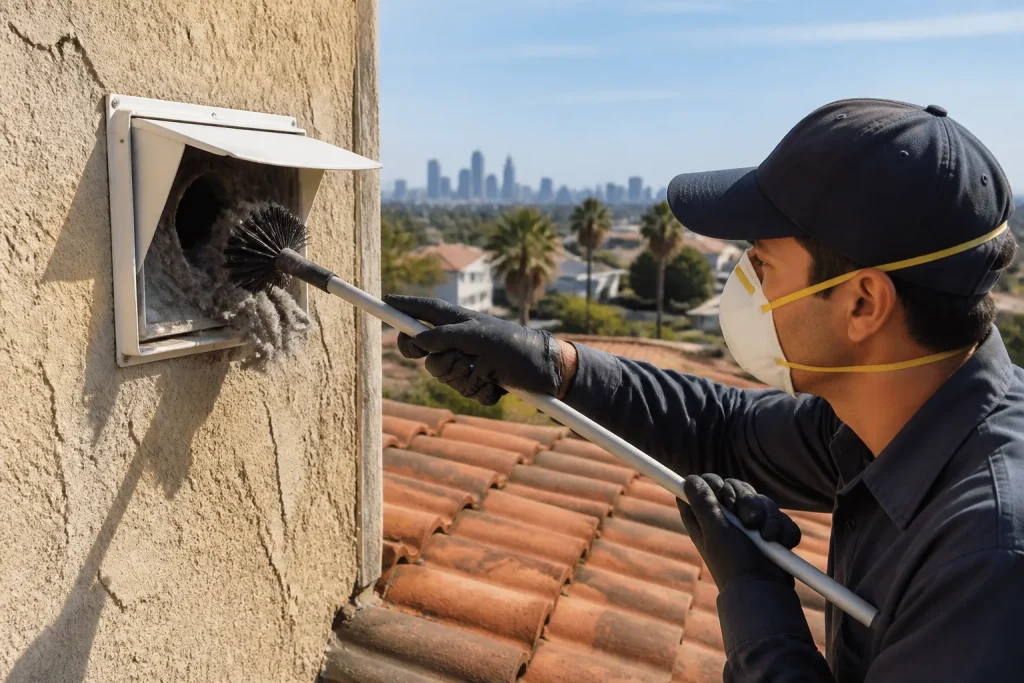
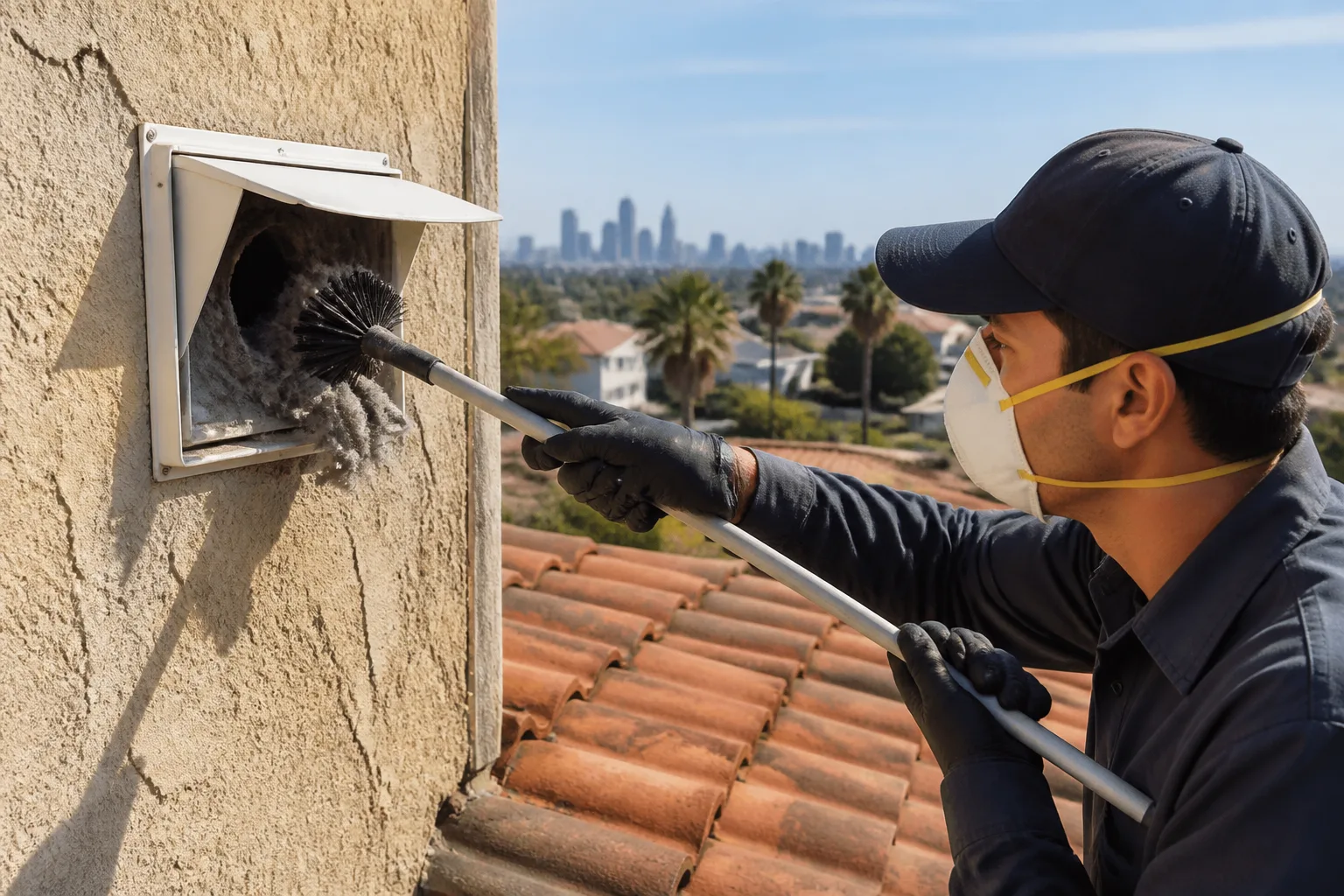
In most single-family homes across Los Angeles, from Sherman Oaks to El Segundo, the dryer vent runs a short, fairly straight path from the back of the machine to an exterior wall. Eight to twelve feet of rigid metal duct, maybe one elbow, and the vent cap is reachable from the ground. In those cases, annual cleaning handles the problem completely. Lint builds up along the interior walls of the duct, a professional-grade rotary brush attached to a Rotobrush machine scrubs it loose, and the airflow returns. The vent itself is structurally sound; it’s just dirty.
You’ll know you’re in this camp if:
- Your dryer is on an exterior wall and the vent exits directly behind it
- The duct run is under 15 feet with no more than two elbows
- The duct is rigid metal or semi-rigid aluminum, not foil accordion
- Drying times improved after the last cleaning and held for close to a year
- You can see daylight through the vent cap when the dryer is running and the flap is open
One of the things we’ve learned since 2005 is that Los Angeles homes with this straightforward setup rarely need anything more than a thorough clean and a quick check of the exterior cap. The cleaning cost is modest, and the job is done in about an hour. No drama, no upsell.
When the Vent Is the Problem, Not the Lint
Now for the Los Angeles scenario that keeps us busy: condos, townhomes, and apartment conversions where the dryer sits deep in the unit, far from any exterior wall. The vent gets routed up through a wall cavity, across a ceiling joist bay, and out through a roof cap or a shared chase. That run routinely stretches 20, 25, sometimes 35 feet, with three, four, even five elbows to navigate around framing and plumbing. And here’s the thing no amount of cleaning can fix: every foot of length and every elbow adds airflow resistance. A dryer motor can only push so hard.
Industry airflow standards set a maximum equivalent duct length of 35 feet for most residential dryers, where each 90-degree elbow counts as 5 feet. A 30-foot run with three elbows is effectively 45 feet. You can clean that vent until the brush comes back white, and the dryer will still struggle, still run long cycles, still accumulate lint faster than it should, because the route itself is overworking the machine. In those cases, the best fix is a reroute: shortening the run, moving the exit to a closer wall, or upgrading to a booster fan installed inline. That’s a repair decision, and it’s an investment that pays for itself in lower utility bills and a dryer that doesn’t die five years early.
Crushed, Kinked, and Foil-Accordion Ducts: Why Some Vents Should Be Replaced Before Cleaning
Los Angeles has a lot of older buildings, and older buildings have a lot of foil accordion ductwork behind the walls. Flexible foil is easy for installers to snake through tight spaces, which is exactly why it’s everywhere in pre-1980s apartments and early condo conversions. It’s also the single worst material for a dryer vent. The ridges catch lint on every cycle. The foil crushes when a framer or plumber leans on it. And over time, with heat cycling, the material degrades into brittle fragments that separate at the seams.
If your vent is foil accordion and it’s been there for 20 or 30 years, cleaning it is a temporary gesture. The lint returns within months because the surface itself is a lint trap. The correct move is replacement with rigid 4-inch metal duct, then a maintenance cleaning schedule from there. It’s more work up front, usually requiring a section of drywall to be opened, but it’s a one-time fix that a cleaning never provides.
We’ve seen the difference firsthand. Last month over in Westchester, we pulled a crushed section of foil vent out of a wall in a 1987 townhome. The duct had been flattened to about an inch and a half at one spot, probably by a plumber installing a pipe sometime in the ’90s. The homeowner had paid for two cleanings in three years, and the dryer was still taking 90 minutes a load. We replaced the damaged section with rigid metal, cleaned the full run, and the dry time dropped to 40 minutes. No new dryer, no fancy equipment. Just a correctly built vent.
Clean-Only Visit vs. Full Vent Inspection with Airflow Measurement
Most dryer vent cleaning companies in Los Angeles offer one service: clean the duct and leave. That’s fine when the vent is short and straight, because there’s nothing to diagnose. But when you call a company because your dryer takes two cycles to dry a towel, cleaning alone doesn’t answer the question of why. Is it the vent length? A crushed section? A failed exterior damper? A partially detached duct behind the wall?
A full inspection measures what’s actually happening. We use an anemometer at the exterior vent cap to measure airflow velocity before and after the clean. If the post-clean numbers are still low, the vent has a structural problem, and we can tell you exactly where the restriction is and what it’ll take to fix it. That’s a different conversation than “we cleaned it, good luck.”
Morton’s approach is built around this distinction. Our written price is provided before any work starts, and if inspection shows a repair is needed, we do the cleaning that day and give you a fixed quote for the repair separately. You decide. There’s no surprise upsell when the technician opens the wall access, because the price for everything we recommend is on paper before we touch anything.
Los Angeles Building Codes and Multi-Unit Dryer Vent Routing
The Los Angeles Building Code follows the California Mechanical Code for dryer exhaust systems, and it’s worth knowing a few specifics if you live in a condo or townhome. Dryer vents must terminate outside, not into a crawlspace, attic, or garage. They must be independent of other exhaust systems, so a shared vent riser serving multiple units is a code violation in most cases. And they must be constructed of smooth metal duct, not foil, for any new or modified installation.
Roof-vented dryers are common in multi-unit Los Angeles buildings where each unit’s vent stack rises through a chase to a roof cap. These can be difficult to service from inside the unit, and they collect condensation that turns lint into a paste along the vertical run. If you notice your dryer vent leaking water or the flap at the roof cap barely moving, the problems might not be within your unit at all. That’s the kind of scenario where a technician with experience in LA’s older multi-unit construction is the difference between a fixed problem and a recurring one.
How to Decide: A Simple Framework
So you’ve got a dryer that’s running long and a vent you’re not sure about. Here’s the decision path we walk families through on a daily basis:
- Inspect the visible duct. If you can see foil accordion behind the dryer, replacement is likely in your future. Rigid metal is a good sign.
- Measure the approximate run. Exterior wall vent with a short path? Clean and done. Interior laundry with a long, multi-elbow route? Get an airflow measurement.
- Look at your drying history. Did cleaning fix the problem last time, and did it stay fixed for a year? If yes, annual cleaning is your maintenance. If the long dry times returned within six months, something structural is going on.
- Get a written price before any work. Any reputable Los Angeles company will tell you the cleaning cost upfront and flag potential repair costs before starting. If they won’t, call someone else.
The Bottom Line
Annual dryer vent cleaning in Los Angeles is the right service for most homes, and it’s far cheaper than replacing ductwork or buying a new dryer. But when the vent itself is the problem, whether it’s a 35-foot multi-elbow run in an old condo, a crushed section behind the drywall, or degraded foil-accordion tubing from the Reagan administration, cleaning alone will not solve it. The honest move is a full inspection with airflow measurement, a written price for everything before work begins, and a commitment to only recommend a repair when the numbers justify it.
If you’re in Los Angeles and you want someone to look at your dryer vent without trying to sell you a new duct system you don’t need, call Morton’s at (323) 918-4345. We’ll measure, clean, and tell you the truth. We use professional-grade equipment from Rotobrush, Nikro, and Honeywell, and every visit includes shoe covers, drop cloths, and a written price before any work starts.
Related services in Los Angeles: Dryer Vent Cleaning in Los Angeles and Air Duct Cleaning in Los Angeles. And for a full picture of who we are, start at our Morton’s Air Duct Cleaning home page.
Frequently Asked Questions
You need to look at what the vent is made of and how it’s routed. If it’s foil accordion duct, it should be replaced with rigid metal because the ridges trap lint faster than any cleaning can keep up with. If the vent runs more than 35 equivalent feet, including 5 feet for each elbow, the route itself is the problem and cleaning alone won’t fix it. If you can see crushed or kinked sections at the wall connection, replacement is the only effective remedy. We can tell you within about 15 minutes of inspection which situation you’re in. Call (323) 918-4345 for an exact assessment.
Dryer vent cleaning in Los Angeles typically ranges from $150 to $400 depending on the length of the run, the number of elbows, the vent’s accessibility, and whether roof access is required. Condo and townhome jobs with roof terminations and long vertical runs fall toward the higher end. Morton’s provides a written price before any work starts, so families can plan before they commit. Call (323) 918-4345 for a free estimate.
Los Angeles has a large stock of older apartment buildings and condo conversions with long, multi-elbow vent routes and foil accordion ductwork. Both conditions accelerate lint accumulation because every turn and every ridge in the foil creates resistance and a place for lint to catch. A straight 10-foot metal vent might go a year between cleanings; a 35-foot foil vent might clog in four months. If you’re in the second group, a repair or reroute is the only lasting fix. Call (323) 918-4345 and we’ll explain what’s in your walls.
If your vent is short, straight, and accessible at both ends, you can make a meaningful dent with a brush kit and a shop vacuum. But we’d caution against DIY work on anything with a long run, a roof termination, or foil duct you can’t fully inspect. Lint is combustible, and a partially dislodged clog can create a worse restriction than the one you started with. For anything beyond a simple accessible run, it’s safer and ultimately cheaper to have a trained professional handle it. Call (323) 918-4345 and we’ll take care of it properly, with shoe covers and drop cloths included, and a written price before any work starts.
Written by Paul Adeyemi, Owner at Morton’s Air Duct Cleaning, serving Los Angeles since 2005.
Need Air Duct Cleaning Help?
Call Morton's Air Duct Cleaning - licensed & insured, here with fast after-hours help in Los Angeles.
(323) 918-4345