
Emergency Air Duct Cleaning Near Me: What Los Angeles Homeowners Should Do First
If you have smoke pouring through your registers, a dead-animal smell in the hallway, or visible mold around your vents, turn off your HVAC system at the thermostat right now. Don’t switch the fan to “on” to air things out. Don’t crank the AC to push the smell away. Kill the system completely, then keep reading. The first hour of decisions matters more than the cleaning itself, and most Los Angeles homeowners get this backwards while searching for the fastest appointment.
Here’s the direct answer: in a duct emergency, the correct sequence is shut down the HVAC, close the registers in affected rooms if the smell or contamination is localized, assess which of four emergency types you’re dealing with, then call a specialist who can tell you honestly whether cleaning will actually solve the problem. If you’d rather skip the assessment and talk to a human, call Morton’s Air Duct Cleaning home at (323) 918-4345 and we’ll walk you through it.
Step One: Turn the System Off Before You Do Anything Else
The single most common mistake we see in Los Angeles homes is the homeowner running the HVAC fan while they wait for a technician. It feels productive, like you’re keeping air moving. But if the problem is smoke ash from a wildfire, a dead rodent in the ductwork, or mold spores around the coil, running that fan is distributing the problem into every room in the house. What was contained to one section of ductwork becomes a whole-home issue in about twenty minutes.
At the thermostat, switch the system to “off,” not “auto” and not “fan on.” If you have a smart thermostat, pull up the app and make sure no scheduled program will kick the system back on while you’re waiting. This matters in Los Angeles because our HVAC systems run more months of the year than most cities, and the temptation to keep the house cool while you sort things out is real. Don’t do it.
If the odor or contamination seems localized to one or two rooms, close those registers by hand. This is a temporary measure, not a fix, but it reduces cross-contamination. In a two-story Los Angeles house, the upstairs often shares trunk lines with the downstairs, so closing registers alone won’t fully isolate anything. It just buys you a little margin until a professional arrives.
The Four Types of Duct Emergencies in Los Angeles (And What to Do for Each)
Not every “emergency” is an emergency. Some are urgent. Some are important but can wait until tomorrow. Knowing which one you have changes what you should do in the first hour.
1. Wildfire Smoke and Ash Infiltration
This is the Los Angeles-specific emergency that most generic duct cleaning articles never address. When a wildfire burns within ten or twenty miles of your home, ash particles get pulled through your HVAC intake, especially if you ran the system during an AQI spike. The ash doesn’t just sit in the filter. It settles inside the duct runs, on the blower motor, and around the evaporator coil. Then every time the system cycles, it re-releases fine particulate into your living space.
What to do first: turn the system off. Check your filter. If it’s gray or black, replace it with a clean one but keep the system off until a professional can inspect the ductwork. Homes in Sherman Oaks, Encino, and Studio City within a few miles of recent burn zones need a different conversation than routine cleaning. This is a smoke-ash removal job, and you want a company that uses HEPA-filtered negative air equipment from brands like Abatement Technologies, not a shop vac attached to a vent.
2. Dead Animal or Pest Evidence in the Ductwork
If you smell something that reminds you of rotting meat or a sour, musty odor coming from one register but not others, there’s a decent chance a rodent, bird, or squirrel died in your ductwork or got trapped and couldn’t get out. Los Angeles has no shortage of roof rats, especially in neighborhoods with mature trees like Pasadena, Silver Lake, and the Hollywood Hills.
What to do first: don’t try to retrieve it yourself. We’ve pulled a dead rat out of a flex duct in a Hancock Park crawlspace where the homeowner had spent two hours with a grabber tool and a flashlight, and by the time we arrived the smell had spread through three bedrooms. Turning the system off is step one. Step two is calling a professional who can locate the carcass, remove it, and then clean and sanitize the affected duct section. Duct cleaning alone sometimes isn’t enough here; the area may need targeted antimicrobial treatment, and any torn flex duct from the animal’s entry needs repair.
3. Suspected Mold Odor from the Registers
A musty smell that comes from every register, not just one, tends to point to the coil or drain pan rather than the ducts themselves. If the odor is strongest in one register, it could be localized duct contamination. Either way, running the fan spreads spores. This is the emergency where we most often tell people to slow down before paying for a clean.
Here’s the honest part. If you have visible mold growth inside your ductwork, cleaning alone may not solve it. In some cases, the porous flex duct needs replacement. If the mold is on the evaporator coil, that’s an HVAC service issue first, and a duct cleaning second. A reputable company will tell you this before quoting a job. We’ve walked away from potential bookings in Los Angeles because the right answer was mold testing or HVAC repair first, and the homeowner deserved that truth even though it meant we didn’t get the job that day.
4. Post-Flood or Water Intrusion Moisture
If water got into your ductwork, whether from a leaking roof in a heavy Los Angeles rain season, a burst pipe, or a flooded crawlspace, the clock starts ticking on mold growth within 48 hours. This is the one emergency where you shouldn’t wait to see if it dries out on its own. Ductwork in a humid crawlspace doesn’t dry quickly, and by the time you smell it, microbial growth is already underway.
What to do first: turn the system off. If you can safely access the wet area, remove standing water and run a dehumidifier near the affected space. Then call a company that can inspect the ductwork for water damage, not just clean it. Some flex duct will need replacement rather than cleaning. The right technician will tell you which sections can be saved and which can’t.
What “Emergency Air Duct Cleaning” Actually Means in Los Angeles Logistics
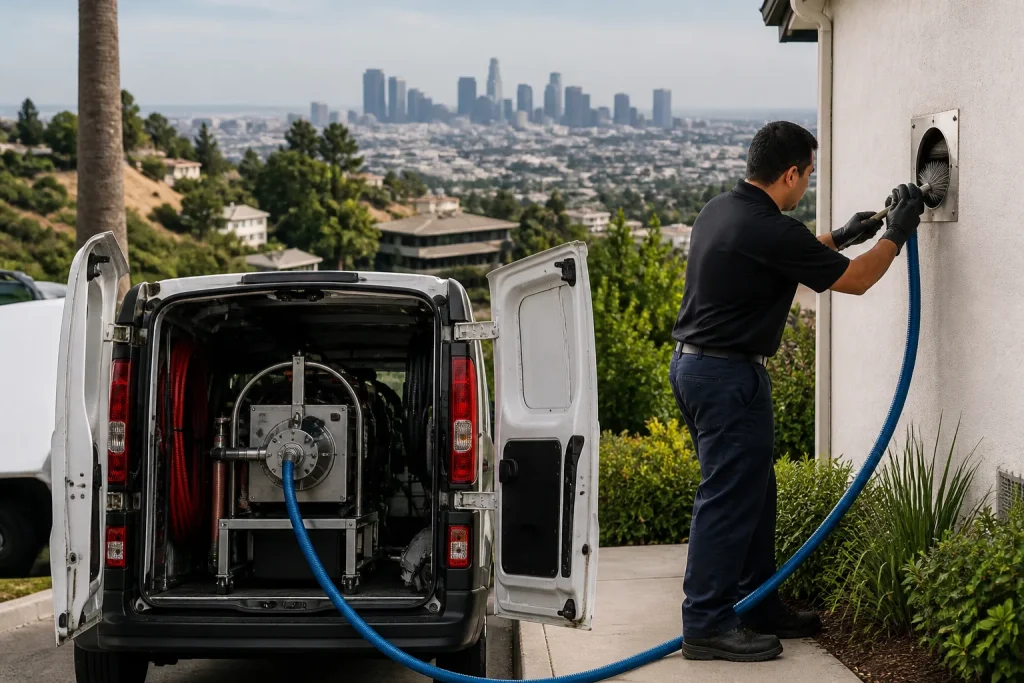
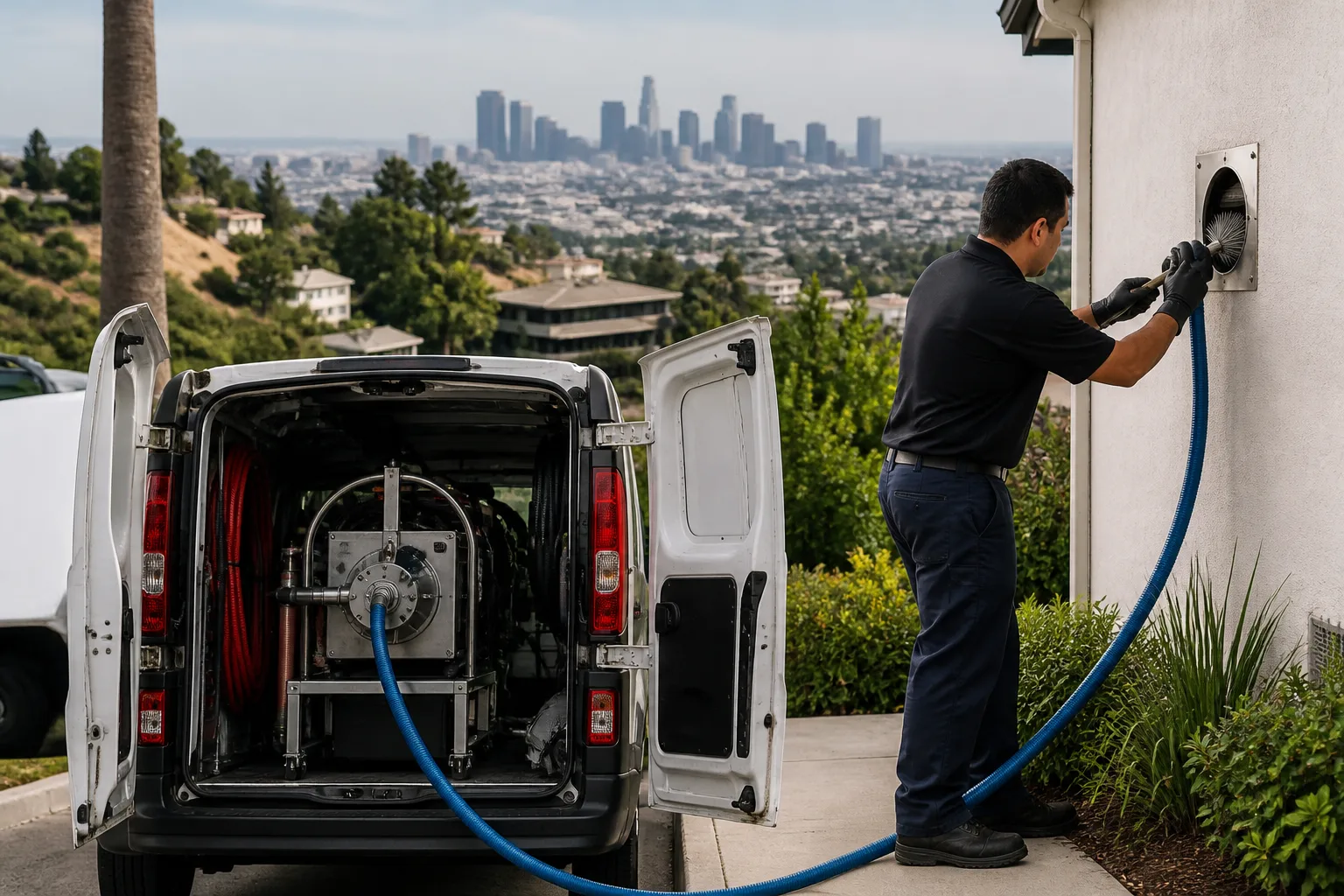
Let’s set realistic expectations. A thorough air duct cleaning of a typical Los Angeles home, say 1,500 to 2,500 square feet, takes four to eight hours when done properly with professional equipment like Rotobrush and Nikro systems. There is no legitimate ten-minute duct cleaning. Companies that advertise “express” service in under an hour are doing something less than a full clean, or they’re using equipment that can’t reach the full duct run.
Same-day availability in Los Angeles genuinely exists. Our company has live people answering the phone 24/7, and depending on the call volume, we can sometimes get a crew out the same day. But “same day” means the technician arrives, assesses, and starts the process. It doesn’t mean they finish in two hours. For a real emergency, the first visit is often about stopping the spread: turning off the system, sealing off affected registers, locating the source, and building a plan. The full clean may happen the next morning.
Anyone who promises emergency mold remediation in four hours without first looking is overselling. Trust the company that asks questions first: When did this start? Which rooms are affected? Did you run the system after you noticed? Have you had any water intrusion in the last month? Those questions tell you they understand how air moves through a Los Angeles house and that they’re not just booking slots.
When Duct Cleaning Isn’t Enough (And a Good Company Should Tell You)
Here’s the conversation we have with Los Angeles homeowners more often than they expect, and it’s the one every honest company should be willing to have: sometimes duct cleaning won’t solve your emergency.
If you have a dead animal, cleaning removes the contamination but you also need to find and seal the entry point, or you’ll repeat this in six months. If you have visible mold on duct surfaces, the porous material may need replacement, not just a scrub. If you have water-damaged flex duct, it gets replaced, not cleaned. If your smoke-ash problem came from a wildfire, your coils need cleaning too, not just the duct runs.
Before you book anything, ask the company one question: “After you look at my system, will you tell me if cleaning isn’t the right fix?” If the answer is anything other than an immediate yes, keep looking. We’d rather lose a job by being honest than take money for a clean that won’t solve your problem. That’s the whole point of the Cedarwell Care Promise and our 365-Day Done Right Promise. If it’s not done right, we make it right. But “right” sometimes means telling you to call an HVAC company or a mold remediation specialist first.
What to Look for in an Emergency Duct Cleaning Company in Los Angeles
When you’re in a hurry, it’s easy to skip due diligence. Don’t. Here’s the short checklist that matters most:
- A real person answers the phone. In an emergency, you don’t want a voicemail or a web form. You want a human who can tell you whether they can get someone out today and what the visit will cost.
- A written price before work starts. This is non-negotiable. Every job we do includes a written price before anything begins. If a company won’t put the number on paper before the crew arrives, that’s a red flag, especially in the duct cleaning industry where bait-and-switch pricing is notorious.
- Shoe covers and drop cloths, without you having to ask. Your emergency shouldn’t mean a mess in your home. Our technicians arrive in uniform, put on shoe covers at the door, and lay drop cloths in the work path. That’s not an upgrade. It’s the standard.
- Professional equipment, not entry-level rental gear. The difference between a $99 duct cleaning and a real one is partly the equipment. We run Rotobrush, Nikro, and Abatement Technologies equipment that actually agitates and extracts debris from the full duct run, not just the first few feet of the register.
- Proof of the work. Ask what you’ll get after. We photograph the clean-up before we leave, so you can see your ducts before and after, not just take our word for it.
One more thing worth saying: a technician who works quietly around your sleeping toddler and your nervous dog is not a bonus feature. It’s professionalism. If you’re in Los Angeles with kids and pets, you know exactly what we mean. The best emergency service is one that solves the problem without traumatizing the household.
For our standard Air Duct Cleaning in Los Angeles service, the same standards apply: written price upfront, shoe covers, drop cloths, and a photo of the clean-up before we go.
Wildfire Smoke in Los Angeles: The Post-Burn-Zone Conversation
Los Angeles is different from most cities when it comes to duct emergencies because of fire season. When AQI numbers climb into the unhealthy range and ash drifts over neighborhoods from Malibu to Altadena, your HVAC system becomes a particulate delivery system if it’s running. What most homeowners don’t realize is that a standard pleated filter, a MERV 8 from the hardware store, does little to stop fine wildfire ash. The ash that gets through settles in your ductwork, on your blower, and around your coil.
After a significant smoke event, the conversation isn’t about routine duct cleaning. It’s about removing combustion particulates from surfaces where they’ll off-gas and re-enter your air for months. Homes near burn zones benefit from a full system cleaning, including coils and blower, and upgraded filtration going forward. If you live in the San Fernando Valley or the hills and you ran your AC during the last major smoke event, your ducts have ash in them even if you can’t see it. We’ve seen returns in Burbank and Glendale with a fine gray film inside three months after the fire that caused it was long forgotten.
When the smoke is from a wildfire, duct cleaning plus a better filter is the right combination. A Honeywell or Aprilaire media filter cabinet can capture far more of what Los Angeles air throws at your system than a one-inch disposable filter, and we routinely recommend that upgrade alongside a post-smoke deep clean.
If you’re also noticing lint buildup or longer drying times, that’s a separate issue worth addressing. Our Dryer Vent Cleaning in Los Angeles service handles that side of things, and after a wildfire event, dryer vents can clog with ash too.
The Bottom Line
In a duct emergency, the first move isn’t the phone. It’s the thermostat. Turn the system off, close what you can, identify which of the four emergency types you have, and then call a company that will ask questions before quoting a price. Don’t run the fan. Don’t try to DIY a dead animal. Don’t accept a quote from anyone who hasn’t seen the system and put a written price in front of you.
If you’re in Los Angeles and you need help sorting out a duct emergency, call (323) 918-4345. A live person answers, we’ll walk through what you’re seeing and smelling, and we’ll give you honest guidance on what happens next, whether that’s same-day service or a referral to the right specialist. Estimates are free, and you’ll never get pressure from us. Just straight answers.
Frequently Asked Questions
Emergency air duct cleaning in Los Angeles typically runs $450 to $850 for a full-home system clean, depending on home size and the type of contamination. Smoke ash and dead animal removal cost more than routine dust cleaning because they require specialized sanitizing. A written price before work starts is the standard you should insist on. Call (323) 918-4345 for an exact quote on your Los Angeles home, estimates are free.
No. Running your HVAC system during a duct emergency, whether it’s smoke, mold odor, or a dead animal, spreads contamination throughout the house. Turn the system off at the thermostat and close registers in affected rooms. This is the single most important first step and it costs you nothing.
Sometimes, yes. It depends on call volume and the nearest available crew. A real emergency visit is often about assessment and containment first, with the full clean scheduled the same day or the next morning. Be wary of anyone promising a full emergency clean in under two hours. Real duct cleaning on a Los Angeles home takes four to eight hours with professional equipment.
If you see visible mold inside the ductwork or the odor is coming from the HVAC coil, you may need remediation or HVAC service before duct cleaning. A reputable company will tell you this upfront. Ask any company you call whether they’ll tell you if cleaning isn’t the right fix for your situation. If they hesitate, call someone else.
Written by Paul Adeyemi, Owner at Morton’s Air Duct Cleaning, serving Los Angeles since 2005.
Need Air Duct Cleaning Help?
Call Morton's Air Duct Cleaning - licensed & insured, here with fast after-hours help in Los Angeles.
(323) 918-4345