
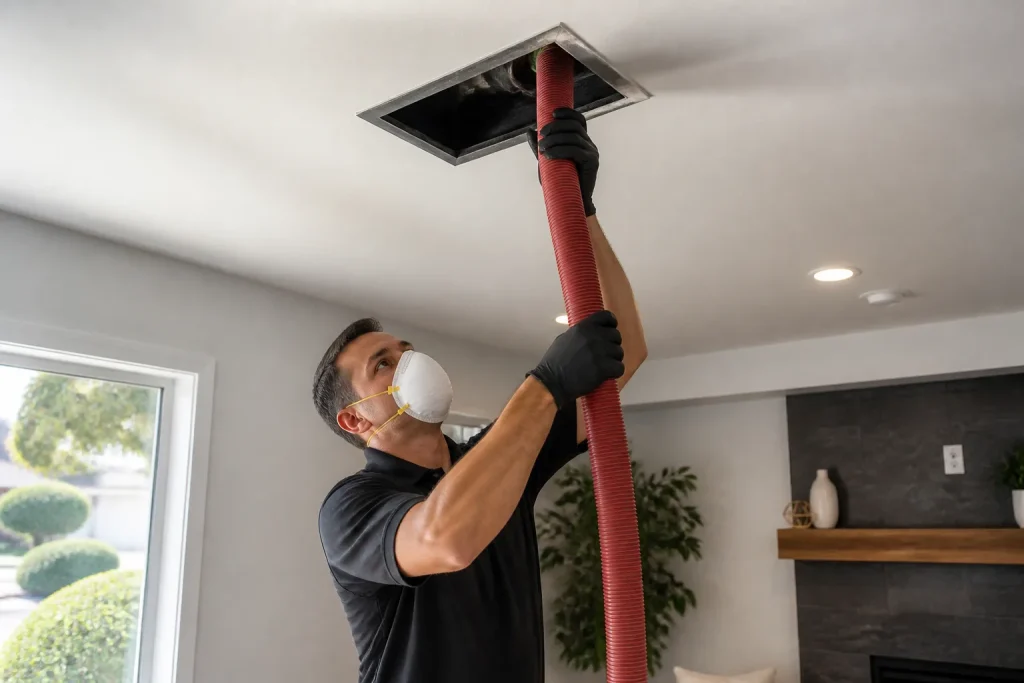
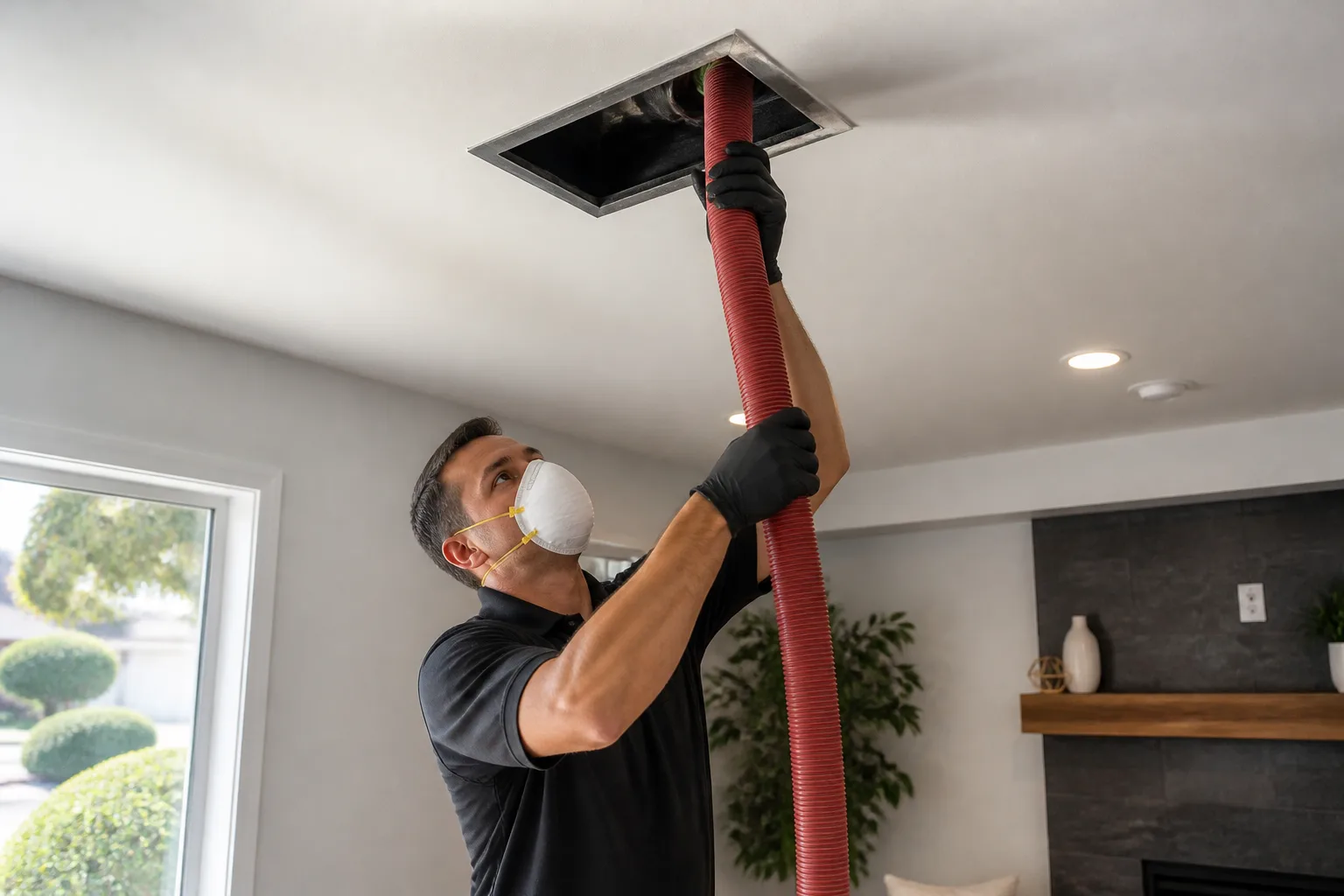
Questions to Ask Before Hiring a Air Duct Cleaning Company
Before you hire anyone to clean your home’s air ducts, ask these seven questions: what equipment they use, whether they give a written price before work starts, how they contain dislodged debris, what their callback policy actually covers, whether they carry both liability and workers’ comp insurance, how they protect your floors and furniture, and whether they’ll show you proof the work was done. A 2023 EPA consumer advisory notes that improper duct cleaning can dislodge debris and actually worsen indoor air quality, which means a bad hire leaves your house worse than before anyone showed up. If you’d rather skip the research and just talk to someone who can walk you through all of this, call (323) 918-4345.
Most homeowners are asking the wrong questions. They lead with “how much?” and “how fast?” when the questions that actually protect their family are about suction ratings, containment methods, and what happens if something goes wrong after the crew pulls out of the driveway. Here’s the full list, and why each one matters.
1. “What Equipment Are You Using, Specifically?”
This is the question that separates legitimate technicians from van-and-vacuum operators, and it’s the one almost nobody asks. A real air duct cleaning company can name the brand and model of their equipment without hesitation. If the answer is “a truck-mounted vacuum,” that’s not an answer. That’s a dodge.
Here’s why it matters. Air duct cleaning only works when the vacuum creates enough negative pressure to pull debris out of the duct walls while agitation loosens what’s stuck. The machines that do this well come from companies like Rotobrush and Nikro, which build professional-grade systems designed specifically for duct interiors. Entry-level gear or a shop vac attached to a hose won’t create the suction needed to pull years of dust, pet hair, and construction debris out of a 20-foot duct run.
- Ask: “What brand and model of equipment do you use?”
- Good answer: “We use Rotobrush and Nikro systems with HEPA filtration.”
- Red flag: “We have professional equipment” with no brand name.
- Follow-up: “What’s the suction rating?” Legitimate technicians know their CFM (cubic feet per minute).
In Los Angeles, newer homes built after 2010 often have flexible ductwork that older, aggressive cleaning tools can tear. The right equipment matters even more when the duct material itself is delicate. We use equipment from Rotobrush and Nikro specifically because it’s designed to clean thoroughly without damaging the ducts, and we’ve had to repair work done by crews who showed up with gear that was never meant for residential duct systems.
2. “Will I Get a Written Price Before You Start?”
The bait-and-switch is this industry’s worst habit. A company quotes one number on the phone, then the technician walks through the house and suddenly the price doubles because of “extra vents” or “unexpected buildup.” A written price before work begins, on every visit, no exceptions, is the single most important financial protection you can ask for.
Ask the question directly: “Will you put the price in writing before any work starts?” Then watch how they respond. A company that hesitates, hedges, or says “we’ll see once we get in there” is telling you they plan to raise the number.
- Ask: “Can you put the price in writing before you begin?”
- Good answer: “Yes. We’ll walk the home, give you a written price for the whole system, and that’s the number on the invoice.”
- Red flag: “We give estimates, but the final price depends on what we find.”
For a typical single-family home in Los Angeles, a full air duct cleaning generally runs between $450 and $800 depending on the square footage, the number of vents, and whether the system includes multiple zones. That’s the honest range. If someone quotes you $99 for a whole-house duct cleaning, that’s a teaser price designed to get a technician in the door, and the real number will come later.
3. “How Do You Keep Dislodged Debris From Settling in My Home?”
This is the question that protects your kids and your furniture. The whole point of air duct cleaning is that you’re agitating dust, pet dander, and debris that’s been sitting in the ducts. A careless crew will send some of that into the air, where it drifts down onto your couch, your dining table, and the crib by the window. The EPA advisory from 2023 specifically warns about this: improper cleaning can make your indoor air worse, not better.
Containment means creating negative pressure inside the duct system so debris gets pulled into the vacuum, not pushed into your living room. It means sealing off registers, protecting the areas around vents, and using drop cloths under every work area.
- Ask: “What’s your containment protocol during the job?”
- Good answer: “We use drop cloths, shoe covers, and negative-pressure equipment to keep debris from entering the living space.”
- Red flag: A blank stare, or “we bag the vent openings” with no mention of negative pressure.
At Morton’s, the Cedarwell Care Promise includes shoe covers and drop cloths on every visit, included in the price. But containment goes further than that: it means the equipment itself is set up to pull air out of the ducts at specific pressure levels, and it means the floor around every register is covered before the vent cover comes off. We’ve walked into Los Angeles homes where previous crews left a fine layer of duct dust across the entire living room. That’s not cleaning. That’s just moving the problem around.
4. “What Exactly Does Your Warranty Cover?”
Most companies say they offer a “satisfaction guarantee.” Ask them what that means in writing. A vague promise is worthless the moment you find dust blowing out of your vents two weeks after the job.
Compare these two answers:
- Vague: “We guarantee your satisfaction.”
- Specific: “If the job isn’t done right, we come back and make it right within 365 days.”
Those are completely different commitments. The second one is a 365-Day Done Right Promise, and it’s the standard we hold ourselves to at Morton’s. It means the warranty isn’t just a phrase on the invoice: it’s stamped on every job, and it has a timeframe. If something’s not right, you call, and we come back. Full stop.
When you ask about callbacks and warranties, listen for whether the company sounds comfortable being held accountable. A legitimate crew already plans for the possibility that something might need a second look. A fly-by-night operator will change the subject.
5. “Do You Carry Both Liability and Workers’ Comp Insurance?”
This question feels administrative, and that’s exactly why so many homeowners skip it. But here’s the scenario that matters: if a technician gets hurt on your property and the company doesn’t carry workers’ compensation insurance, you could be the one on the hook for medical bills. That’s not a hypothetical. It’s how uninsured subcontractors operate, and it happens in Los Angeles every month.
General liability insurance covers damage to your home. Workers’ comp covers injuries to the crew. You want both, and you want to see the certificate before the appointment, not asked for at the door when it’s too late to verify.
- Ask: “Can you send me certificates for general liability and workers’ comp before the appointment?”
- Good answer: “We’ll email them right over.”
- Red flag: “We’re insured, don’t worry” with no paperwork.
Every Morton’s technician is background-checked and arrives in uniform. That matters for who’s walking through your front door, but the insurance certificates are what protect you if something actually goes wrong. Ask for both.
6. “How Do You Protect My Floors and Furniture?”
This sounds obvious, but the details tell you how the crew behaves when nobody’s watching. Shoe covers. Drop cloths laid down before any equipment comes through the door. Corners taped, not just draped. Pet areas covered. A crew that protects your floors is a crew that respects your home, and that respect shows up in how carefully they clean the ducts themselves.
Ask the question and watch for specificity:
- Ask: “What exactly do you do to protect my floors and furniture?”
- Good answer: “Shoe covers on every visit, drop cloths under every work area, and we cover furniture near the registers.”
- Red flag: “We’re careful” with no details.
The shoe covers and drop cloths should be included, not an add-on line item. At Morton’s, they’re part of the Cedarwell Care Promise on every single job. If a company charges extra to protect your floors, that tells you how they think about the house they’re standing in.
And for households with pets: ask if the products used around vents and ducts are pet-safe where available. A technician who thinks about the dog sleeping in the hallway is thinking about your whole house, not just the ductwork.
7. “Can You Show Me the Work Was Actually Done?”
Air ducts are hidden. You can’t see inside them without a camera, and most homeowners wouldn’t know a clean duct from a dirty one just by looking at the vent opening. That’s why before-and-after proof matters. It’s the difference between trusting the invoice and trusting your own eyes.
A legitimate company will offer one of two things: before-and-after photos from a duct inspection camera, or a walkthrough showing the containment setup and the cleanup afterward. At Morton’s, every completed job includes a photo of the clean-up before the crew leaves. You shouldn’t have to ask whether the mess is gone; you should be able to see it.
- Ask: “Will you show me before-and-after photos of the ducts and the work area?”
- Good answer: “Yes, here’s what we’ll capture and when.”
- Red flag: “Just trust us, it’s clean now.”
In Los Angeles, where many homes have ducts running through attics and crawl spaces, the temptation to cut corners is real because nobody’s watching. Photos remove that temptation entirely.
What the Good Companies All Have in Common
If you’ve read this far, you’ve noticed a pattern. The good answers all share the same structure: they’re specific, they’re written down, and they’re offered before you ask. A company that volunteers its equipment brands, its containment protocol, and its written pricing isn’t trying to hide anything because it doesn’t have anything to hide.
Here’s the short version of the checklist:
Key Takeaways: The Seven Questions to Ask
- Equipment: What brand and model do you use? (Listen for Rotobrush or Nikro, not “truck-mounted vacuum.”)
- Pricing: Will I get a written price before any work starts?
- Containment: How do you keep dislodged debris from settling in my home?
- Warranty: What does your callback policy cover, specifically, and for how long?
- Insurance: Can you send certificates for liability and workers’ comp before the appointment?
- Protection: What exactly do you do to protect my floors and furniture?
- Proof: Will you show me before-and-after photos of the ducts and the clean-up?
That’s the whole list. Seven questions, none of them about speed, because speed was never what mattered. A company that cleans your ducts in 45 minutes and leaves dust on the couch didn’t save you time. They just made the job faster for themselves.
We pulled a contractor-grade HVAC filter out of a duct run over in the West Adams district last month that had been there since the house was built in 2014. It sat in the main return line, blocking airflow and collecting a layer of dust that looked like felt. The homeowner had lived with reduced airflow for nearly a decade and never knew, because the previous “cleaning” had never actually scoped the return line. That’s the pattern we see in Los Angeles over and over: crews who clean the visible vents, skip the main runs, and leave the real problems untouched.
When the Job You’re Asking About Is the Job We Do Every Day
We’re Morton’s Air Duct Cleaning, and this is the conversation we have with homeowners every single day. Founded in 2005, we’ve been part of the Cedarwell family since the beginning, and every technician works to the Cedarwell Care Promise: written pricing, shoe covers and drop cloths, background-checked technicians in uniform, and a photo of the clean-up before the crew leaves. Our equipment comes from Rotobrush, Nikro, and other industry-trusted brands like Honeywell, Aprilaire, Abatement Technologies, and Guardsman because the machines matter as much as the people running them.
We also offer Dryer Vent Cleaning in Los Angeles for homeowners who want to handle the other half of the ventilation system while we’re there. And if you’re researching this for a home anywhere in the Los Angeles area, start with our Air Duct Cleaning in Los Angeles page for local pricing and service details.
The Bottom Line
You don’t need to become an HVAC expert to hire a good air duct cleaning company. You need seven questions and the willingness to call a few companies and ask them. The ones who answer specifically, in writing, with brand names and protocols and certificates, are the ones who will actually do the job well. The ones who dodge, generalize, or rush to “how fast can we book you” are the ones who will leave your home worse than they found it.
If you’re in Los Angeles and want to skip the phone interviews, call Morton’s Air Duct Cleaning at (323) 918-4345 for a free estimate. You’ll get a written price before any work starts, a 365-Day Done Right Promise on every job, and a live person on the phone, 24/7.
Frequently Asked Questions
For a typical single-family home, a full air duct cleaning in Los Angeles runs between $450 and $800 depending on square footage, the number of vents, and whether the system has multiple zones. Be wary of quotes under $200: in this industry, a low upfront number usually means a technician arrives and finds reasons the price needs to double. Call (323) 918-4345 for a written price based on your specific home.
Cheap quotes come from cheap equipment, skipped containment, or a teaser price that grows once the crew is inside your home. A company charging $99 for a whole-house job cannot cover the cost of professional-grade equipment, insurance, and trained technicians at that rate. They make up the difference by adding fees during the visit or by simply not cleaning the main duct runs. Ask for the brand of equipment and a written price before work starts, and the difference becomes clear.
Ask for before-and-after photos from a duct inspection camera, and confirm that you’ll receive a photo of the clean-up before the crew leaves. A legitimate company will show you the work without being asked twice. If they can’t or won’t show you, that’s a sign the job may not have been done thoroughly.
The honest answer for most Los Angeles homes is every 3 to 5 years, depending on pets, allergies, recent construction, and whether anyone in the home has respiratory conditions. Homes with shedding pets, visible dust buildup around vents, or a renovation that kicked drywall dust into the ducts may need it sooner. If you’re not sure, a reputable company will inspect and tell you honestly whether the ducts are ready for cleaning or whether you can wait another year. Call (323) 918-4345 and we’ll help you figure out what your home actually needs.
Written by Paul Adeyemi, Owner at Morton’s Air Duct Cleaning, serving Los Angeles since 2005.
Need Air Duct Cleaning Help?
Call Morton's Air Duct Cleaning - licensed & insured, here with fast after-hours help in Los Angeles.
(323) 918-4345