
Rotobrush Air Duct Cleaning in Los Angeles: A Homeowner’s Guide
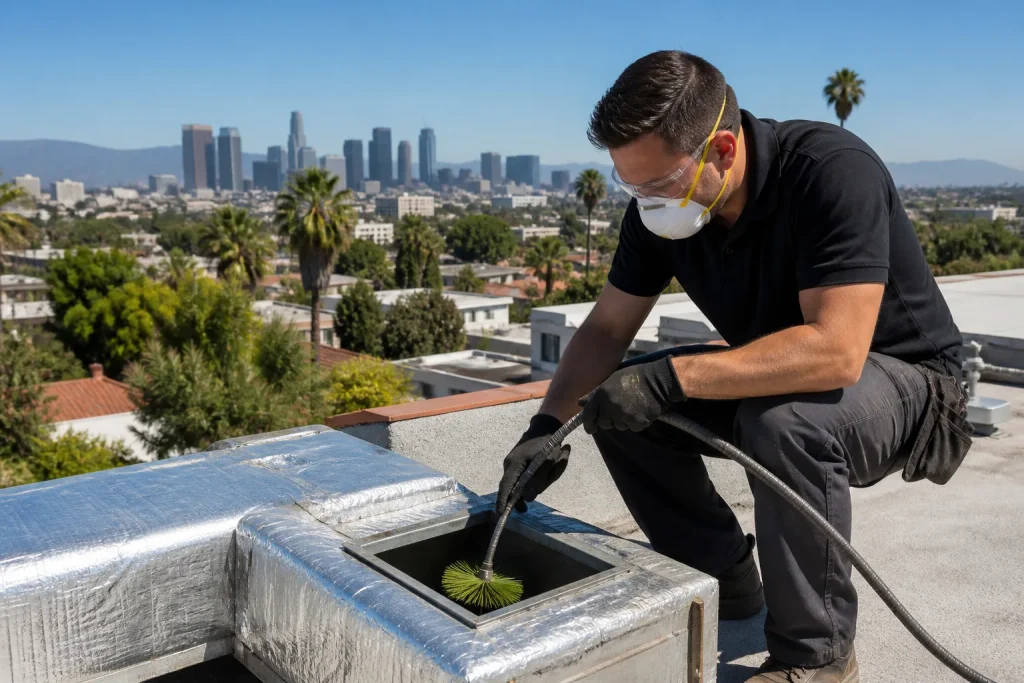
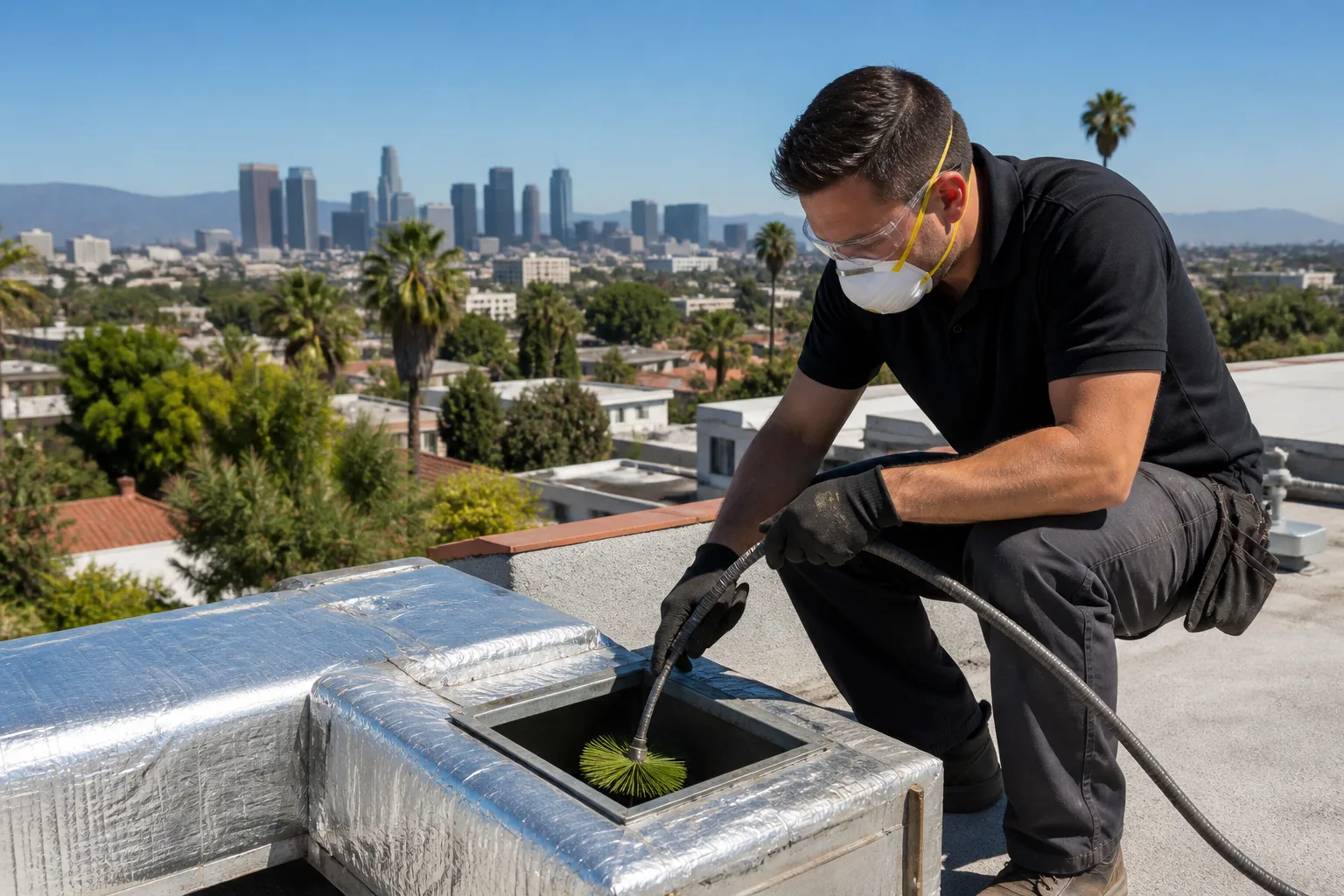
A Rotobrush system cleans air ducts by running a powered brush and a vacuum line through the ductwork at the same time, so loosened debris gets pulled out immediately instead of falling deeper into the system. In Los Angeles, where HVAC ducting in post-1990 homes is almost always built on flexible, foil-backed duct board rather than rigid sheet metal, whether that brush actually touches the duct walls depends entirely on the technician choosing the right brush head diameter for your duct size. If you’d rather skip the research and just get a written quote for your home, call Morton’s Air Duct Cleaning at (323) 918-4345.
A Rotobrush machine running in a flexible duct that is the wrong diameter does not clean. It just spins in the center while the vacuum pulls air. And a homeowner watching from the hallway has no way to tell the difference until the filters clog again three months later. We have been cleaning ducts in Los Angeles since 2005, and we have taken apart enough systems to know what a proper Rotobrush pass should leave behind on camera footage. This guide explains what that looks like, and what to ask before you let anyone run a brush through your ductwork.
Key Takeaways
- Rotobrush cleans by running brush agitation and vacuum extraction simultaneously, which keeps dust from getting blown deeper into the duct run.
- The system only works correctly if the brush head matches the duct diameter and the technician adjusts speed and air pressure for the material type.
- Rigid metal ducts and flexible duct board need different Rotobrush settings to avoid tearing or incomplete cleaning.
- Camera footage after the pass is the only reliable way for a homeowner to verify the clean actually happened.
- A Rotobrush machine alone does not constitute a complete cleaning protocol. Negative air pressure containment matters just as much.
How a Rotobrush Works, and Why the Simultaneous Design Matters
Most duct cleaning methods follow a two-step sequence: push a brush through to knock debris loose, then come back with a vacuum to collect what has now settled at the bottom of the duct. The problem is that between those two steps, some of what you loosened has already moved downstream. In a two-story Los Angeles home where the return air chase runs through a wall cavity, that displaced dust often ends up sitting on top of the air handler or inside a duct run nobody opens up again.
The Rotobrush design pairs a rotating agitation brush with a high-volume vacuum intake at the same tool head. The brush physically scrubs the duct surface while the vacuum removes the dislodged particles in the same moment. The system connects to a central collection unit that a technician runs from the house, and the hose reaches runs up to about 50 linear feet from the access point. That reach matters in Los Angeles because many homes here put the air handler in a garage or hallway closet, with long flexible runs snaking through a crawlspace above the ceiling.
We use Rotobrush equipment at Morton’s Air Duct Cleaning home as part of a cleaning protocol, not as the whole story. The brush-and-vacuum head does the agitation work, but it should be paired with negative air pressure containment, which is where our Nikro equipment comes in. Nikro’s negative air machines seal and pressurize the system during the cleaning so that particles are not escaping into the living space while the Rotobrush runs. We explain this to customers because it is the difference between a surface-level dusting and a clean that holds up through a Santa Ana season.
Rigid Duct vs. Flex Duct: Why Setup Changes Everything
Homes built in Los Angeles before about 1990 often have rigid galvanized steel ductwork. It is durable, it holds up to repeated cleaning, and it responds well to an aggressive brush speed. Homes built after 1990, particularly the thousands of stucco box and Spanish Revival homes across the San Fernando Valley, the Westside, and the South Bay, almost always have flexible duct board. Flex duct has an inner foil or plastic liner wrapped in insulation. It cleans differently.
Here is what a properly configured Rotobrush job looks like for each material:
- Rigid metal ducts: The technician should use a stiff-bristle brush head sized to match the duct diameter, and run it at a higher rotation speed. Metal ducts can handle real agitation, and the camera footage afterward should show the metal reflecting light, not a gray film.
- Flexible duct board: The brush head should be one size down from what you would use on rigid metal of the same nominal diameter. The inner liner has some give, and an oversized brush can tear it. The technician should run at a lower rotation speed and let the vacuum do proportionally more of the work.
- Duct board with foil facing: Common in Los Angeles attic installations. The facing must stay intact to prevent fiberglass particles from the duct board itself from entering the airstream. Our technicians configure the Rotobrush to clean the surface without peeling that facing back.
We have pulled enough torn flex duct out of Los Angeles attics to know that a rushed brush pass is worse than no cleaning at all. One job we did in Reseda last fall: the homeowner had another company clean six months earlier. The attic flex runs had visible rip lines where a stiff-bristle brush had been forced through at the wrong diameter. The duct was leaking conditioned air into the attic, and the homeowner’s electric bill showed it. That is what happens when the machine is right and the setup is wrong.
What a Correct Rotobrush Pass Looks Like on Camera Footage
Every legitimate air duct cleaning company in Los Angeles should offer you before-and-after camera footage of your ductwork. A Rotobrush pass is not visible from the hallway. The camera footage is the only evidence you will ever have that the work happened. Here is what to look for:
- Before footage: You should see visible gray or brown coating on the duct surfaces. It may look like fine dust, or in worse cases, a crust. In Los Angeles homes with pets, you will often see hair matted against the duct walls, especially in the return air chase.
- After footage: The duct surface should look clean. On rigid metal, the metal should be bright and reflective. On flex duct, the foil or plastic liner should look smooth and one uniform color, without visible tear lines or loose insulation debris.
- Coverage: The after footage should show the full run, not just the first three feet from the access point. Ask to see the farthest reaches of the longest runs. That is where debris settles, and that is where a poorly done job leaves everything behind.
- Air handler area: The technician should also show you the plenum box, the evaporator coil if accessible, and the return air drop. A Rotobrush cleans the duct runs, not the coil, but the coil area should be inspected and noted on the after footage.
Our crews complete a video inspection on every duct cleaning job we do in Los Angeles, and we walk the homeowner through the footage before we leave. That is part of the Cedarwell Care Promise: a photo of the clean-up before the crew walks out the door, and footage of the duct work itself. Paul Adeyemi, our owner, started this company in 2005 because he kept hearing from Los Angeles homeowners who had paid for duct cleaning and had no way to know if anything actually happened. The camera footage solves that problem permanently.
Questions to Ask Any Company Claiming to Use Rotobrush
Rotobrush is a brand name that gets thrown around a lot in Los Angeles marketing copy. Here is the uncomfortable truth: owning a Rotobrush machine and using it correctly are two different things. When you call a company and they say they use Rotobrush equipment, ask these questions before you book:
- What brush head diameter are you planning to use for my duct size? A technician should be able to answer this from your home’s square footage and general build era, even before seeing the system in person. If they cannot give you a straight answer, that is a warning sign.
- How many linear feet of duct are you actually cleaning, and how do you know? A proper Rotobrush run is measured. The hose has footage markers, and the technician should log how far the brush traveled on each run. If the answer is vague, the job will be vague.
- What containment method are you using while the brush runs? The Rotobrush vacuum catches most of what the brush loosens, but it does not create full negative air pressure on the entire system. A proper job pairs the Rotobrush with a HEPA-filtered negative air machine that seals the system and keeps particles from migrating into the house. Ask whether they use one.
- Will I get camera footage of the before and after, or are you going to describe it to me? There is no legitimate reason to decline camera footage. In Los Angeles, where attic ductwork is often inaccessible to homeowners, the camera is your only window into the work.
We run into homeowners every week who had prior cleanings done by companies that could not answer these questions. Sometimes the work was adequate and the technician just did not document it. Other times, the homeowner paid for a full-system clean and got three runs done from a single hallway vent. You cannot tell the difference without asking. At Morton’s, our technicians log every run and walk you through the footage before we pack up. We have been part of the Cedarwell family of companies since day one in 2005, and the CarE values that govern our work include showing you exactly what we did.
How Much Does Rotobrush Air Duct Cleaning Cost in Los Angeles?
Air duct cleaning in Los Angeles typically costs between $450 and $1,200 for a whole-home system, depending on square footage, number of system zones, and the condition of the ductwork. A two-zone system in a 2,000-square-foot home in Los Angeles generally lands between $600 and $900. A single-zone condo or smaller home often runs $450 to $600. Larger homes with multiple air handlers, or systems with significant pet hair or construction debris, can exceed $1,100.
Here is a rough breakdown of what drives the price in the Los Angeles market:
- Square footage and duct linear feet: More runs means more time and more hose footage. A 3,500-square-foot Los Angeles home with long attic runs will cost more than a 1,400-square-foot ranch in the Valley.
- System condition: If the ducts have not been cleaned in ten or twenty years, or if the previous owner left seven years of golden retriever fur in the return, the job takes longer and costs more.
- Accessibility: Los Angeles homes often have air handlers in tight attic spaces or garage closets. If we need to cut new access panels to reach certain runs, there is a small additional cost.
- Add-on services: Dryer vent cleaning, coil cleaning, or sanitizing treatments add to the total but are optional. We will give you a written price line-by-line before any work starts.
We do not do per-vent pricing. It encourages the kind of bait-and-switch billing that has given this industry a bad reputation in Los Angeles: a low number over the phone, then a much higher invoice once the crew is in your attic. At Morton’s, you get one flat price per system in writing before the Rotobrush ever leaves the truck. That price covers the cleaning, the containment, the before-and-after camera footage, and the shoe covers and drop cloths our technicians put down before they walk into your house. If the job is not done right, the 365-Day Done Right Promise means we come back and make it right. No fine print, no re-inspection fee.
Why a Rotobrush Alone Is Not Enough
Here is something most Los Angeles homeowners do not hear from duct cleaning companies: a Rotobrush is a great agitation and extraction tool, but by itself it does not create the negative air pressure environment that keeps loosened particles from escaping into your home during the cleaning. The brush head has a strong vacuum, yes. But the full system, from return to supply, is under neutral pressure during the pass unless you add containment equipment. That is why we run our Rotobrush equipment alongside Nikro negative air machines on every job.
Think of it this way. When your vacuum cleaner runs in your living room, the nozzle pulls air through a small opening. But if you open a window across the room, the airflow changes dramatically. That is what a negative air machine does for your duct system: it seals the system and maintains directional airflow so that particles move toward extraction, not out through a vent register into your hallway. In Los Angeles, where air quality is already an issue during fire season and smog days, you do not want a cleaning process that disturbs dust and lets it drift back into your home.
We have also paired Rotobrush with Dryer Vent Cleaning in Los Angeles equipment from Guardsman and Abatement Technologies where appropriate, but those are specialized tools for different parts of the home. The point is that a system, not a single tool, is what produces a clean you can see on camera footage and feel in the air a month later.
When to Call a Professional
Air duct cleaning in Los Angeles is not a DIY project, and we say that as people who have seen every attempt. Attic access in most LA homes involves climbing through a hatch in a hallway ceiling, crawling across joists, and working around HVAC components that require training to identify. The risks are not just to your drywall. A wrong-sized brush on flex duct tears the liner. A loose access panel after the job leaks conditioned air into the attic for months before you notice. And the dust kicked up during a cleaning contains whatever has been sitting in those ducts since the last remodel.
If you want a deeper look at how air duct cleaning works in this city, including what a typical Los Angeles home needs and what it costs, read our full guide on Air Duct Cleaning in Los Angeles. We wrote it for homeowners who want to understand the process before they book anyone.
One more thing about our process, because to us this is the whole point. Our technicians wear shoe covers from the moment they enter your home. We lay drop cloths over the floors we will walk, including the carpeted hallway that leads to the attic hatch. We run quiet tools during nap hours when you tell us a toddler is asleep. We choose pet-safe cleaning products where available. And before we leave, we show you a photo of the clean-up so you can see your floors look the way they did when we arrived. That is the Cedarwell Care Promise, and it applies to every job we do in Los Angeles, no exceptions.
The Bottom Line
Rotobrush is one of the best agitation-and-extraction systems on the market for Los Angeles ductwork, but only when paired with proper containment and set up for your specific duct type. Ask about brush head sizing, linear footage logged, negative air containment, and camera footage. A company that can answer all four questions clearly is a company that actually uses the equipment they advertise. In Los Angeles, we are one of the few that does, and we are happy to show you the footage from any job we have done. If you are ready to get a written price for your home’s ductwork, call Morton’s Air Duct Cleaning at (323) 918-4345 for a free estimate. We will tell you exactly what will happen, exactly what it will cost, and exactly what it will look like when we are done.
Frequently Asked Questions
Yes, if it is done correctly. Rotobrush cleans by running brush agitation and vacuum extraction at the same time, which removes debris from the duct run without pushing it deeper into the system. In Los Angeles homes with flex duct, the technician must select the correct brush head size for the duct diameter, or the pass will not actually clean anything. Call (323) 918-4345 for a written quote from Morton’s Air Duct Cleaning, and ask to see before-and-after footage from previous Los Angeles jobs.
A full-system Rotobrush cleaning in Los Angeles typically takes three to six hours, depending on the size of the home, the number of air handlers, and how many linear feet of ductwork are involved. A single-zone condo might run two to three hours. A two-story home in the Valley with long flex runs and pet hair buildup usually runs four to six hours. The speed of the pass matters less than the footage logged and the evenness of the clean.
Yes, if the brush head is too large for the duct diameter or if the technician runs it at the wrong rotation speed. Flexible duct board used in most Los Angeles homes built after 1990 has a foil or plastic inner liner that can tear under aggressive brushing. We configure our Rotobrush equipment with a smaller head and lower speed for flex runs, and the after footage will show the liner intact. If you have had a rough cleaning in the past, ask for camera footage of your current duct condition before booking again.
You should be able to. A proper Rotobrush job includes before-and-after camera footage of every major duct run, including the return air chase and the farthest supply registers. The after footage should show clean, bright metal or smooth flex liner without tear marks or leftover debris. We walk every Los Angeles customer through their footage before we leave, and we leave the video with you. If a company refuses to show you footage, ask a different company.
Written by Paul Adeyemi, Owner at Morton’s Air Duct Cleaning, serving Los Angeles since 2005.
Need Air Duct Cleaning Help?
Call Morton's Air Duct Cleaning - licensed & insured, here with fast after-hours help in Los Angeles.
(323) 918-4345